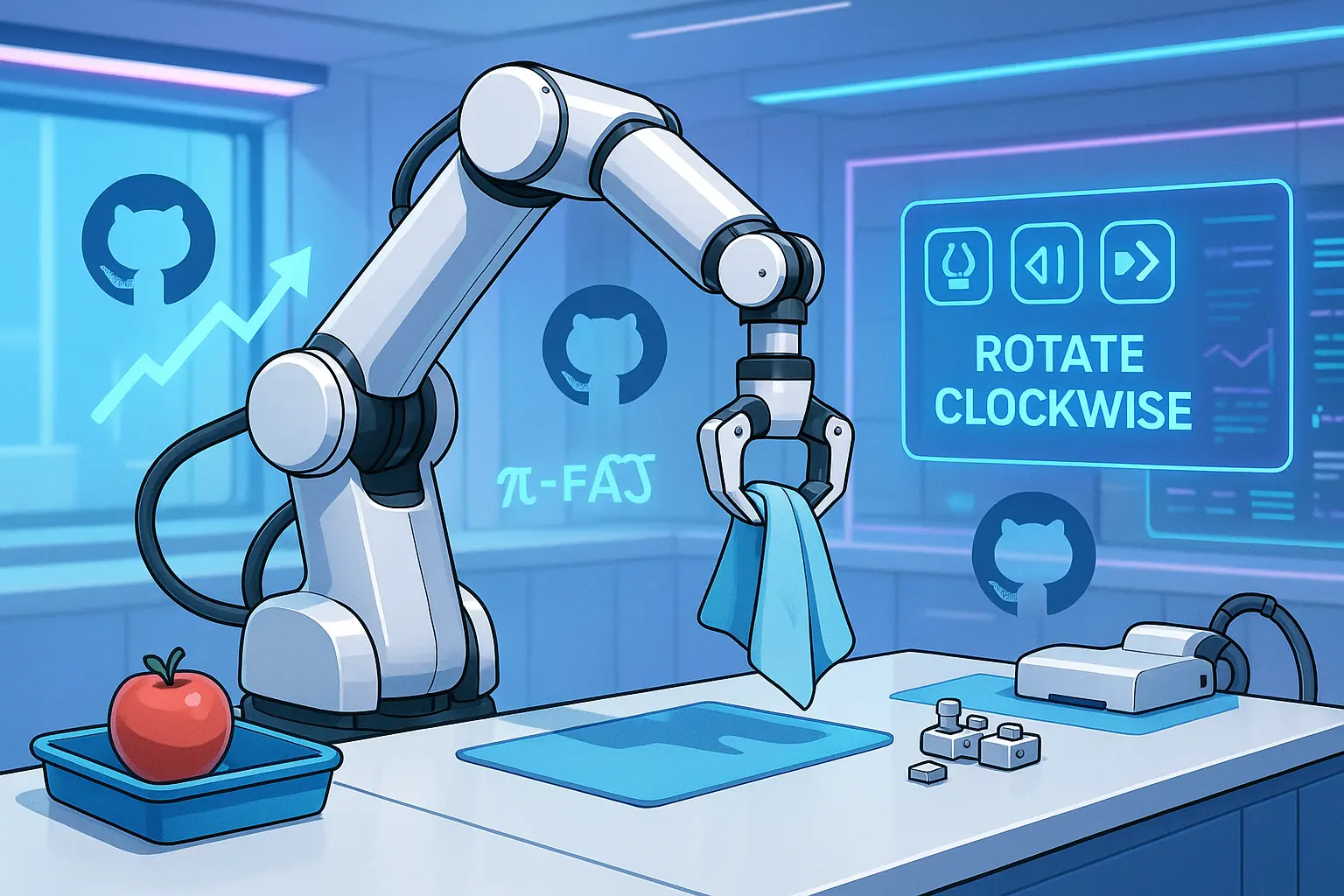
- OpenPI — the open robotics VLA stack — is back on GitHub trending after fresh demos of π₀-FAST manipulating real objects with minimal fine-tuning.
- Robotics creators on X and YouTube shared clips of arms assembling simple rigs and folding soft items, reigniting debate over data scale vs. clever action tokenization.
- Researchers split over whether OpenPI’s approach beats end-to-end visuomotor policies — but the excitement is spiking contributions and forks.
Robotics has a hype cycle of its own, and OpenPI just kicked it into high gear. The Physical Intelligence team’s open-source vision-language-action stack zipped back into visibility after a wave of short demo clips showed π₀-FAST handling dexterous tasks without a roomful of PhDs standing off-camera. For the crowd living at the intersection of RL, imitation learning, and LLM-style instruction following, OpenPI’s sprawling codebase has become a rally point — equal parts inspiration and argument starter.
Why OpenPI feels different
Most public robotics stacks are either narrow task demos or giant research repos with a hundred paper branches. OpenPI tries to be practical: trained checkpoints, clear examples, scripted pipelines for fine-tuning on your own data, and a client that speaks modern MLLM dialects. It’s not plug-and-play — you still need a capable GPU and a compatible arm — but for labs and scrappy startups, it’s a lifeline.
π₀ vs. π₀-FAST vs. π₀.₅ — what the acronyms hide
OpenPI’s family is messy on purpose. π₀ is the flow-based VLA, good at long-horizon action plans. π₀-FAST swaps in an autoregressive policy with a compact action tokenizer, trading some global optimality for responsiveness. π₀.₅ leans into open-world generalization. The active debate online: does the FAST tokenizer’s action vocabulary become a bottleneck? The counter-argument: it’s a feature, not a bug — a way to compress high-DoF control into symbols that survive domain shift.
The demos that set social on fire
In the latest round, creators posted side-by-side clips: a Franka arm selecting mixed items, orienting them correctly, and completing the placement without visible hand-holding. Others showed real-time corrections using language — “rotate more clockwise” — that the VLA turned into fine motor adjustments. That’s catnip for the community because it compresses years of “almost there” research into memes you can show your PM. The comments flooded with “where’s the dataset” and “show your failure cases,” which is exactly the kind of energy that keeps open-source alive.
Setup realities: still not a hobby kit
Even with strong examples, OpenPI isn’t a weekend project. You’re compiling dependencies, wrangling CUDA, validating drivers, and budgeting VRAM. The docs flag memory needs clearly and call out supported OSes. Fine-tuning involves care: aligning camera calibration, action spaces, and safety stops. The good news is that the examples include known-good configs and a client that hides some of the pain — enough that small labs can try without a full robotics team.
The community dynamic: forks, PRs, and “does this work on UR5?”
Search the issues and discussions and you’ll see the same questions again and again: can it run on my arm? What’s the right proprioception encoding? How do I avoid “popping” between action steps? The maintainers answer pragmatically, and the crowd answers each other even faster. There’s a healthy ecosystem of side-repos that contribute checklists, vis tools, and small improvements — the kind of “glue” the main team can’t prioritize but everyone needs.
Why this matters beyond academic cool
Two things changed in the past year: data and transfer. Teams have bigger, more diverse manipulation datasets, and VLAs are getting better at transferring skills across object sets and camera perspectives. OpenPI is interesting because it codifies those advances in a way you can run. If you’re building a startup around pick-and-place, light assembly, or lab automation, you need something you can try tomorrow — not a paper PDF. That’s why the latest demo spike mattered: it convinced skeptics that the repo isn’t purely aspirational.
The pushback and real limits
Skeptics point out that many demos are carefully staged: lighting, camera angles, simplified grippers. They argue that brittle action vocabularies won’t scale to messy factories and warehouses. The maintainers don’t pretend otherwise; they frame OpenPI as a baseline, not a turnkey product. The hope is that more data and cleaner tokenization can bridge the gap. It might — but it will take time and more failed attempts, which open-source can absorb better than most labs.