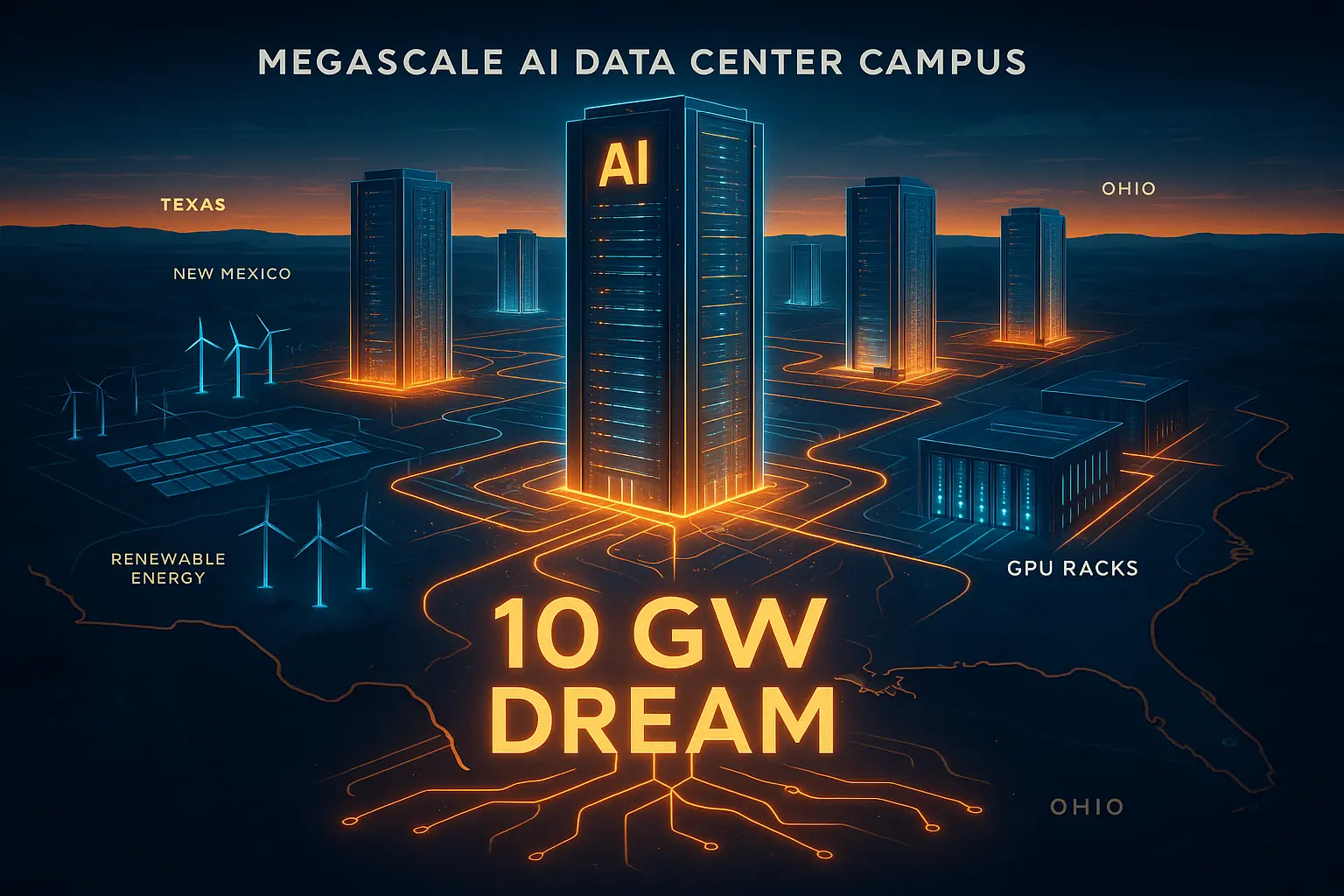
- Seven gigawatts secured – OpenAI’s expansion with Oracle and SoftBank adds five new U.S. data‑center sites, bringing Stargate’s projected capacity to nearly 7 GW and more than $400 billion in investment.
Broad geographical spread – new data‑center campuses will rise in Shackelford County, Texas; Doña Ana County, New Mexico; an undisclosed Midwest location; Lordstown, Ohio; and Milam County, Texas, diversifying the project’s footprint.
Job boom and debt financing – the expansion aims to create 25,000 onsite jobs and will rely on debt financing to lease GPUs, according to sources.
Intro: Stargate’s Rapid Expansion Hits Reddit and LinkedIn
OpenAI’s Stargate new data centers project – a privately funded initiative to build the world’s largest AI super‑computer network – just got even bigger. In a surprise Tuesday announcement, OpenAI, Oracle and SoftBank revealed plans for five additional data‑center sites across the United States. A Reddit post on r/singularity about the news quickly climbed the leaderboard, netting dozens of upvotes and sparking debates over the project’s scale. With these additions, Stargate’s capacity is projected to exceed 7 gigawatts, edging closer to the ambitious 10 GW goal announced earlier this year.
Mapping the New Sites
Texas takes center stage
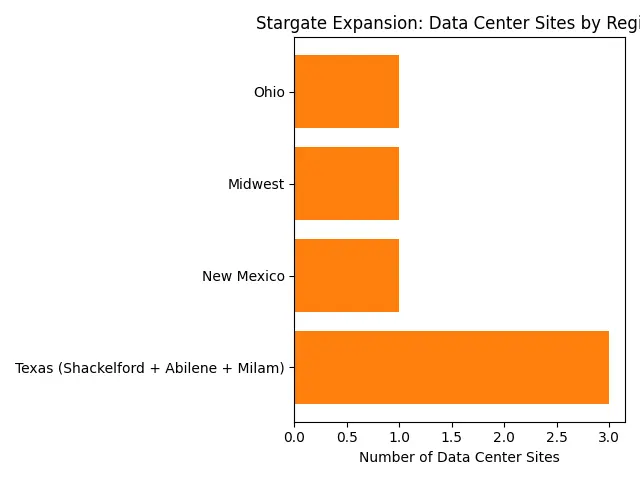
Three of the five new sites are in Texas. Shackelford County will host a fresh build, while Abilene – the project’s first campus – will expand. Milam County will see a new facility developed jointly by OpenAI and SoftBank. Texas offers favorable regulation, abundant land and access to renewable energy, making it an attractive hub for AI infrastructure.
New Mexico and the Midwest diversify the portfolio
To reduce geographic concentration, OpenAI and Oracle will construct a site in Doña Ana County, New Mexico, and another at an undisclosed Midwest location. These sites aim to tap into different electrical grids and benefit from cooler climates, which lower cooling costs.
Ohio welcomes SoftBank
The only non‑Texas/Arizona site announced with SoftBank is Lordstown, Ohio. SoftBank’s involvement signals a global investor appetite for AI infrastructure. The Japanese conglomerate will also co‑develop the Milam County, Texas site, enabling faster deployment and cost sharing.
Financing, Jobs and Political Context
Debt financing and GPU leasing
OpenAI intends to use debt financing to lease chips for Stargate. Leasing allows the company to scale quickly without shouldering the full upfront cost of tens of thousands of GPUs. Oracle, which already hosts OpenAI workloads on its OCI cloud, will operate the new clusters using Nvidia hardware—deepening ties that began with the $100B OpenAI–Nvidia compute agreement. SoftBank brings financial muscle and experience building large‑scale infrastructure in Asia.
Jobs and local impact
The project is expected to create 25,000 onsite jobs, ranging from construction labor and power‑plant technicians to data‑center engineers and AI researchers. Local governments hope the facilities will anchor new technology ecosystems, spurring ancillary businesses and tax revenue.
Government support and geopolitical stakes
U.S. President Donald Trump launched Stargate as a national priority earlier this year. The program aims to build sovereign compute capacity amid concerns about Chinese competition and supply‑chain vulnerabilities. The expansion announcement coincided with legislation that would streamline permitting for large data centers and provide tax incentives for domestic AI infrastructure projects.
Economic and environmental considerations
Beyond headlines about gigawatts and job numbers, the Stargate expansion raises serious questions about environmental sustainability and local economies. Data centers consume vast amounts of electricity and water. Communities near Abilene and Lordstown have already voiced concerns about potential strain on power grids and aquifers. OpenAI insists that it will invest in renewable energy generation and advanced cooling systems, but details remain scarce. Meanwhile, some economists argue that the promise of 25,000 jobs could come with trade‑offs: automation within the facilities may limit long‑term employment, and construction booms often lead to temporary housing shortages and higher living costs. Conversely, local universities see opportunity. They plan to expand engineering programs to supply skilled workers, and regional leaders hope to attract ancillary businesses in software, hardware maintenance and logistics. The balance between growth and sustainability will be a defining challenge for Stargate as it moves from concept to concrete.
Global context and the AI compute race
Stargate is not occurring in a vacuum. Countries across Asia and Europe are launching their own AI super‑cluster initiatives, often with heavy government backing. Japan and South Korea are investing billions into sovereign AI clouds, while the European Union is proposing a network of research data centers tied to public universities. By selecting multiple U.S. locations and partnering with SoftBank, OpenAI aims to secure a strategic advantage before international competitors scale up. Analysts suggest that SoftBank’s involvement may be a bridge to future expansions in Asia or the Middle East. The project’s sheer scale could crowd out smaller players, but it might also spur a renaissance in regional energy infrastructure, from solar farms in the Southwest to next‑generation nuclear reactors in Ohio. In this sense, Stargate is as much about shaping the geography of AI as it is about building servers.
Chart: Stargate Data Centers by Region
Looking ahead
As construction crews break ground, policymakers, industry leaders and community members will watch closely. The coming years will test whether visionary infrastructure projects like Stargate can deliver on their promises without exacerbating inequality or environmental degradation. If successful, Stargate could set a blueprint for balancing national strategic goals with local needs, offering a model for other nations seeking to build sovereign AI compute networks. Either way, the story illustrates how the race for AI dominance is reshaping not just technology but the physical landscapes and economic fortunes of entire regions.