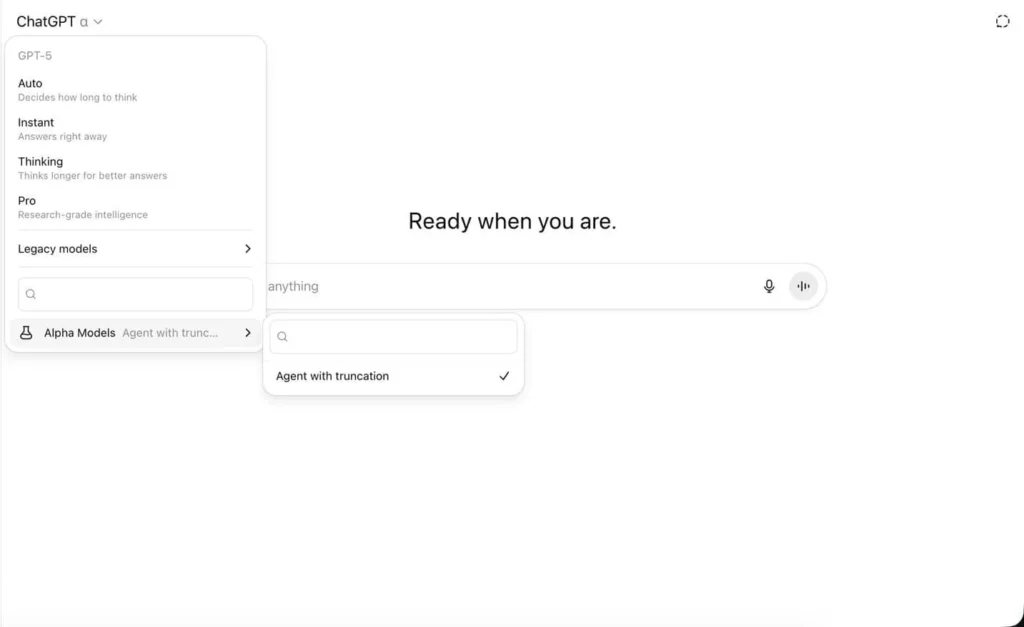
- Hidden model discovered: Users spotted a concealed “Agent with Truncation” option labelled GPT‑Alpha under ChatGPT’s Alpha Models menu.
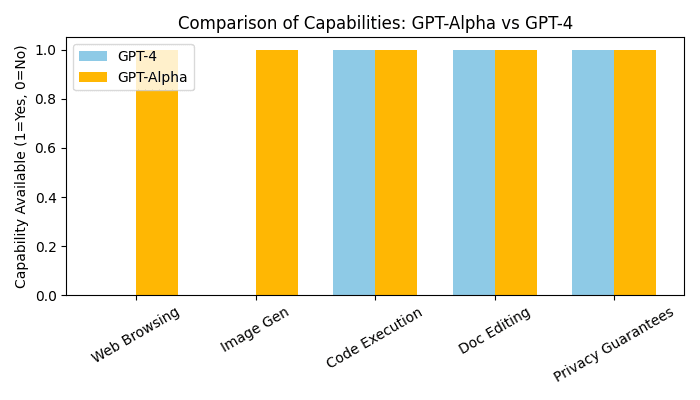
Expanded toolset: Screenshots suggest GPT‑Alpha can browse the web, generate images, write and debug code, and edit documents—capabilities beyond current GPT‑4.
Speculation on GPT‑5: The leak implies the model is built on GPT‑5 with advanced reasoning and may require a premium subscription.
Introduction
A tantalizing GPT-Alpha leak has electrified AI enthusiasts this week. On Sept 24–25, eagle-eyed ChatGPT users noticed a new option hidden under “Alpha Models” labelled Agent with Truncation. Clicking it revealed a menu describing GPT-Alpha as a capable agent that could navigate the web, generate images, write and debug code, and edit documents—functions beyond anything publicly available. The leak set off speculation that OpenAI is secretly testing GPT-5’s agentic abilities. The image below shows the ChatGPT interface where the GPT-Alpha leak was spotted.
History of Model Leaks
OpenAI’s platforms have leaked hints of new models before. In 2023, users briefly saw an “Upgraded Plus” plan that foreshadowed the GPT‑4 release. More recently, hidden buttons pointed to voice mode and vision features weeks before official announcements. The GPT‑Alpha leak fits this pattern, suggesting that OpenAI tests internal prototypes on production servers and occasionally forgets to fully hide them. When sharp observers spot these features, screenshots proliferate across Hacker News, X and Discord, fueling rumours.
Technology and Capabilities
Based on the screenshots, GPT‑Alpha combines capabilities that previously required separate plugins. The description lists four core functions: browsing the web to perform real‑time research, generating images directly within the chat interface, writing and debugging code, and editing documents. In other words, GPT‑Alpha appears to integrate ChatGPT’s browsing, DALL‑E and Code Interpreter tools into a unified agent. A footnote notes that it is “Powered by GPT‑5 for advanced reasoning” and warns that access may be limited and require a higher‑tier subscription.
If true, this would be a significant step forward. GPT‑4 excels at language tasks but relies on add‑ons for other modalities. An integrated agent could seamlessly research a topic, compile information, generate accompanying images, write a report and format it into a document—all within one session. This aligns with OpenAI’s vision of assistants that complete multi‑step tasks rather than just providing answers.
Speculation and Industry Response
The leak spread like wildfire. A thread titled “GPT‑Alpha spotted!” reached the top of Hacker News, drawing hundreds of comments debating authenticity. Some developers dug into OpenAI’s API and found stubbed endpoints referencing alpha models, lending credibility. On X (Twitter), memes about AI agents escaping their cages trended alongside serious analyses of what GPT‑Alpha could mean for the future of work. Discord servers dedicated to AI research lit up with speculation that GPT‑Alpha might integrate plugin toolkits and perform multi‑step tasks autonomously. Some even fantasized about GPT‑Alpha running entire startups or writing novels without human input.
Experts propose several possibilities: It could be an internal prototype accidentally exposed, a next‑generation agent built on GPT‑5 or a forthcoming premium offering designed to monetise advanced features. Regardless, the leak reveals OpenAI’s ambitions to move from chatbots to full‑service digital employees capable of research, coding and content creation.
Comparisons to GPT‑4 and Other Models
How might GPT‑Alpha differ from existing models? GPT‑4 excels at reasoning, summarization and creative writing, but it cannot browse the web natively or execute code without separate plugins. DALL‑E handles image generation. In contrast, GPT‑Alpha appears to unify these capabilities. It may also incorporate features like long‑context understanding, allowing it to handle book‑length documents without truncating. Competitors are racing toward similar goals. Anthropic’s Claude aims to provide safer, more steerable models, while Google’s Gemini seeks to integrate multiple modalities. If GPT‑Alpha leverages GPT‑5, it could set a new benchmark for agentic performance.
Risks and Ethical Questions
An agent that can browse the web, edit documents and run code poses unique risks. Security experts warn that such a model must operate within stringent sandboxes to prevent malicious use or data breaches. Autonomous browsing could lead to the amplification of misinformation if the model cannot distinguish credible sources from dubious ones. There are also concerns about job displacement: a system that writes and debugs code could reduce demand for entry‑level developers. Ethicists argue that society needs to establish guardrails before unleashing agents with wide‑ranging capabilities.
Infrastructure and Pricing
The note about paid access suggests GPT‑Alpha may require a premium subscription. OpenAI has already segmented features across free, Plus and Pro tiers. If GPT‑Alpha represents GPT‑5, the computational resources required will be immense. Operating such an agent could necessitate dedicated data centers and specialized hardware—similar to the massive infrastructure outlined in the OpenAI–NVIDIA $100B compute deal. For a glimpse into the infrastructure arms race behind these models, see our report on OpenAI Stargate New Data Centers, which details multi‑gigawatt data‑centre expansions undertaken by OpenAI and its partners.
Pricing will likely reflect the cost of compute. Some analysts expect a per‑use fee or integration into existing enterprise plans. This raises equity issues: will only wealthy corporations be able to afford top‑tier AI agents? Regulators may eventually step in to ensure fair access.
Competition and Next Steps
The leak puts pressure on OpenAI’s competitors. Google, Meta and Anthropic are all developing their own agentic models. A product like GPT‑Alpha could accelerate the timeline for general‑purpose AI assistants that manage complex workflows. If OpenAI launches GPT‑Alpha soon, it could capture the enterprise market and set de facto standards for agent behaviour, safety and pricing. On the flip side, rushing to release an unfinished agent could backfire if it behaves unpredictably.
Why It Matters
The GPT‑Alpha leak is more than a tantalizing rumour; it’s a window into the future of AI. As models evolve from chatbots to autonomous agents, questions of control, safety and distribution will become central. The leak sparked conversations about what tasks we are willing to delegate to machines and how we might oversee them. It also highlighted the community’s role in shaping AI transparency: without vigilant users, such leaks might go unnoticed.
OpenAI has not commented on the leak. Typically, the company tests features internally before launch, and UI elements may be pushed accidentally. Until official details emerge, the AI community will continue to speculate and prepare for a world where AI agents are not just tools but collaborators.