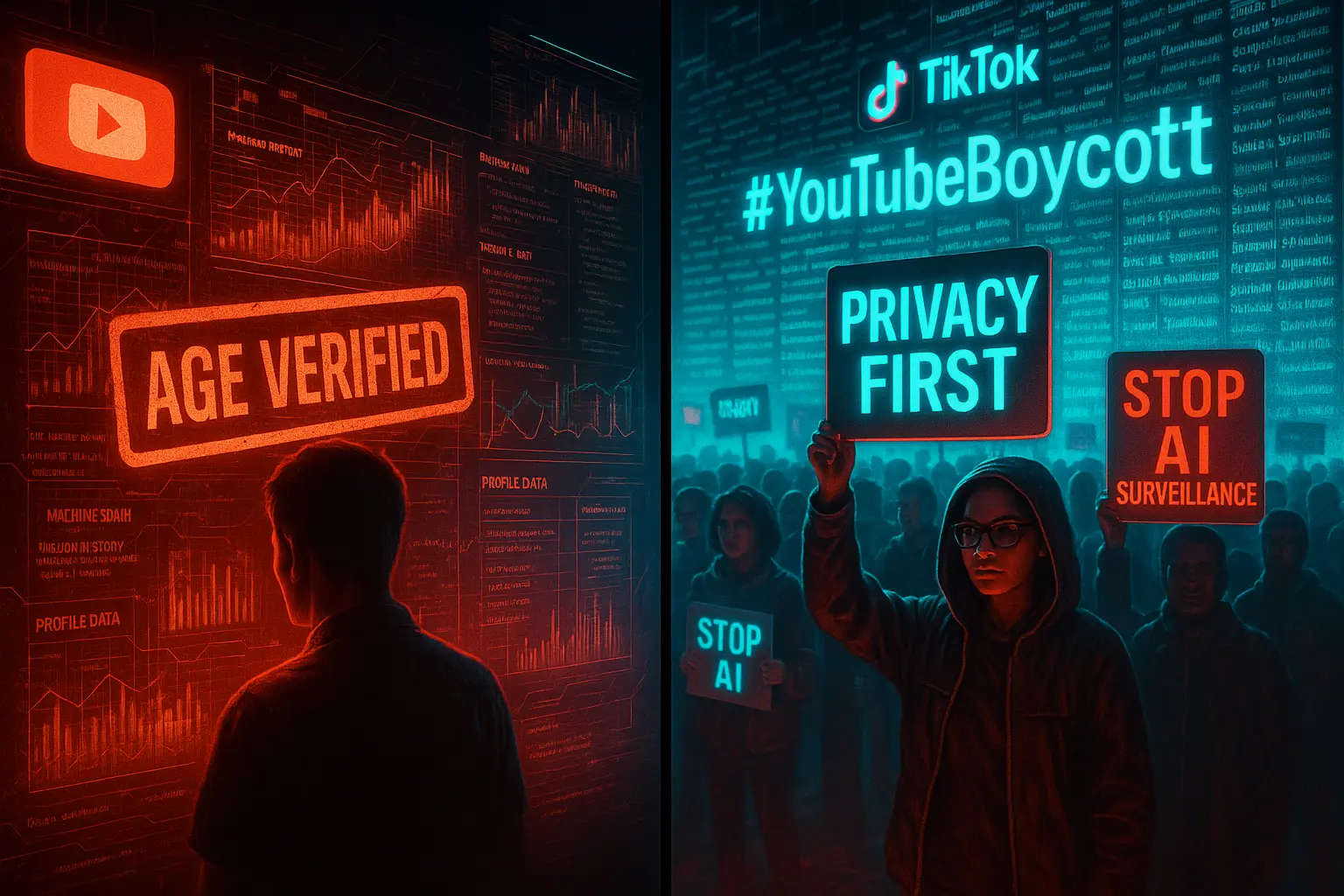
YouTube is testing an AI system that guesses viewers’ ages and forces them to prove adulthood. Petitions against the “creepy” tool have tens of thousands of signatures, and TikTok and Reddit users plan a boycott, questioning the balance between protecting kids and privacy.
-
YouTube is rolling out an AI age‑estimation model in the U.S. that uses viewing habits, search patterns and account age to guess a user’s age. If flagged as a minor, the user must prove adulthood with a credit card, selfie or ID.
-
Two Change.org petitions opposing the tool have amassed 48,000+ and 19,000+ signatures, respectively. A Reddit thread planning a boycott on 13 August garnered hundreds of upvotes and comments.
-
Supporters argue the system protects children; critics call it invasive surveillance disguised as child protection and warn of data privacy risks.
What happened
In early August, YouTube began testing a machine‑learning system to estimate users’ ages. Announced by James Beser, YouTube’s senior director of youth products, the AI model analyses signals such as search and viewing history, device and account age to infer whether a viewer is a minor. Users deemed under 18 are automatically placed under Teen Safety settings: non‑personalised ads, reminders to “take a break,” restricted videos and blocked comments. Adults incorrectly flagged can appeal by uploading a credit card, selfie or government ID.
The rollout, limited to a “small subset” of U.S. users, quickly drew intense backlash. Within hours, a Change.org petition titled “YouTube’s AI Tracks Everything You Watch – Stop This Now!” surged to more than 48,000 signatures. A companion petition called “YouTube – SAY NO TO FLAWED AGE VERIFICATIONS” amassed over 19,000 supporters. Petitioners argue that the AI system amounts to mass surveillance, and they fear being locked out of adult content or forced to hand over sensitive personal information.
On Reddit’s r/youtube, a post titled “Boycott YouTube on August 13th” urged users to log off for a day in protest. The thread gained 400+ upvotes and 600 comments within 12 hours, with many promising to join the boycott. Another post, “If you care about your privacy and AI being used to spy on you, skip YouTube”, echoed the sentiment, lamenting that algorithms would judge people based on the cartoons or gaming videos they watch. A TikTok video warning that viewers might have to show ID just to watch YouTube racked up nearly 1 million views and tens of thousands of likes, fueling the hashtag #YouTubeBoycott.
While some commentators were alarmed, others supported the change. The American Bazaar reported that the AI model aims to deliver age‑appropriate experiences and will only affect a small pilot group YouTube emphasises that adults who appeal won’t have their IDs stored for advertising; a spokesperson told CNN that Google uses advanced security and deletes identity data after verification. The platform added that similar age‑verification tools in the EU and UK have shown “positive results” and that the algorithm improves child protection.
Why This Matters
Everyday workers
YouTube has become a default entertainment and learning platform. For parents, the AI age‑checker may seem like a welcome attempt to shield kids from harmful content. But many adults and teenagers fear being incorrectly flagged and forced to share ID details they don’t want to hand over. The system also assumes that viewing habits reveal age, raising concerns about mislabelling adults who watch animation, ASMR or gaming content. For families without credit cards or IDs, the tool could create access barriers.
Tech professionals
The rollout spotlights the complexities of AI classification systems. YouTube’s model uses behavioural signals to infer age—a powerful approach but one vulnerable to false positives. Machine‑learning engineers must consider the algorithmic bias in labeling certain genres as “young.” Data‑privacy experts like Suzanne Bernstein of the Electronic Privacy Information Center warn that requiring sensitive personal information for appeals is troubling.
For businesses and startups
The backlash shows that even well‑intentioned safety features can alienate users if implemented without transparency. Startups building AI moderation or age‑gating tools should note the importance of user consent and clear communication. Companies risk losing trust if people perceive safety measures as disguised data mining. The trending petitions and planned boycott indicate the reputational harm that can arise from miscommunication.
From an ethics and society standpoint
This controversy touches on the broader debate between child protection and privacy rights. Social media platforms face government pressure—countries like Australia plan to ban under‑16s from social media—yet privacy advocates fear creeping surveillance. If AI can infer age using viewing habits, could it also infer other sensitive traits? Data collected for safety might be repurposed for advertising or law enforcement, raising ethical questions.
Key details & context
-
Pilot program: Only a subset of U.S. users currently see the AI age checker, but YouTube plans to expand if tests show reduced harm.
-
Signals used: The machine‑learning model considers search terms, watch history, account age and device signals to estimate age. The exact algorithm is proprietary.
-
Teen safety features: Users under 18 have no personalized ads, can’t see certain videos, get prompts to take breaks and sleep and have comments disabled. The AI system automatically applies these settings when it senses a minor.
-
Appeal process: Adults flagged incorrectly must prove age via government ID, credit card or selfie; YouTube says this data is not stored for ad targeting and is deleted after verification. Critics worry about potential breaches and misuse.
-
Comparison to other platforms: Reddit and Discord are rolling out similar age‑verification tools to comply with the UK’s Online Safety Act. Governments worldwide are increasing pressure on platforms to protect minors.
Community pulse
Change.org petition (48k signatures): “This policy amounts to mass surveillance disguised as child safety. We shouldn’t have to hand over our passports to watch cat videos.”
u/TechEnthusiast42 (r/youtube, 400+ upvotes): “If you love cartoons or gaming, the AI thinks you’re a kid. Then you need to upload your ID to Google. That’s insane.”
TikToker @PrivacyNerd (1 M views): “YouTube’s about to track everything you watch. If the AI thinks you’re under 18, they’ll ask for your driver’s license. Delete the app on August 13!”
@YTSupport (official): “We’re piloting age‑estimation to better protect teens. Adults wrongly flagged can appeal. ID data is encrypted and deleted after verification.”
What’s next / watchlist
-
Boycott Day (13 August): Thousands of users plan to avoid YouTube to protest the AI system. Petitions continue to gather signatures; if participation is high, YouTube might issue a statement or delay rollout.
-
Regulatory landscape: The Australian government’s bill to ban under‑16s from social media is moving through parliament. Other countries may follow, adding pressure for stricter age‑verification across platforms.
-
Algorithm refinement: Depending on false‑positive rates and user feedback, YouTube may adjust the model to reduce misclassification. Transparency reports on error rates could appease critics.
-
Competitor reactions: Smaller video platforms might seize the moment by promising no AI age estimation. Conversely, mainstream platforms like TikTok and Instagram could adopt similar systems under regulatory pressure.
FAQs
-
How does YouTube’s AI estimate age?
The machine‑learning system uses signals such as watch history, search patterns, device information and account age to infer whether a user is under 18. If it identifies a potential minor, teen safety features automatically activate. -
What happens if I’m flagged as under 18?
Your account will switch to YouTube’s teen experience – no personalized ads, restricted content and prompts to take breaks. To restore full access, you must upload a government ID, a credit card or a selfie for facial age estimation. YouTube says the data is encrypted and deleted after verification. -
Why are people boycotting YouTube?
Many users believe the AI tool invades privacy by collecting watching habits and requiring sensitive documents for appeals. Two petitions have gathered tens of thousands of signatures, and a Reddit‑organized boycott on 13 August encourages people to avoid YouTube to protest the system.